
What this is about
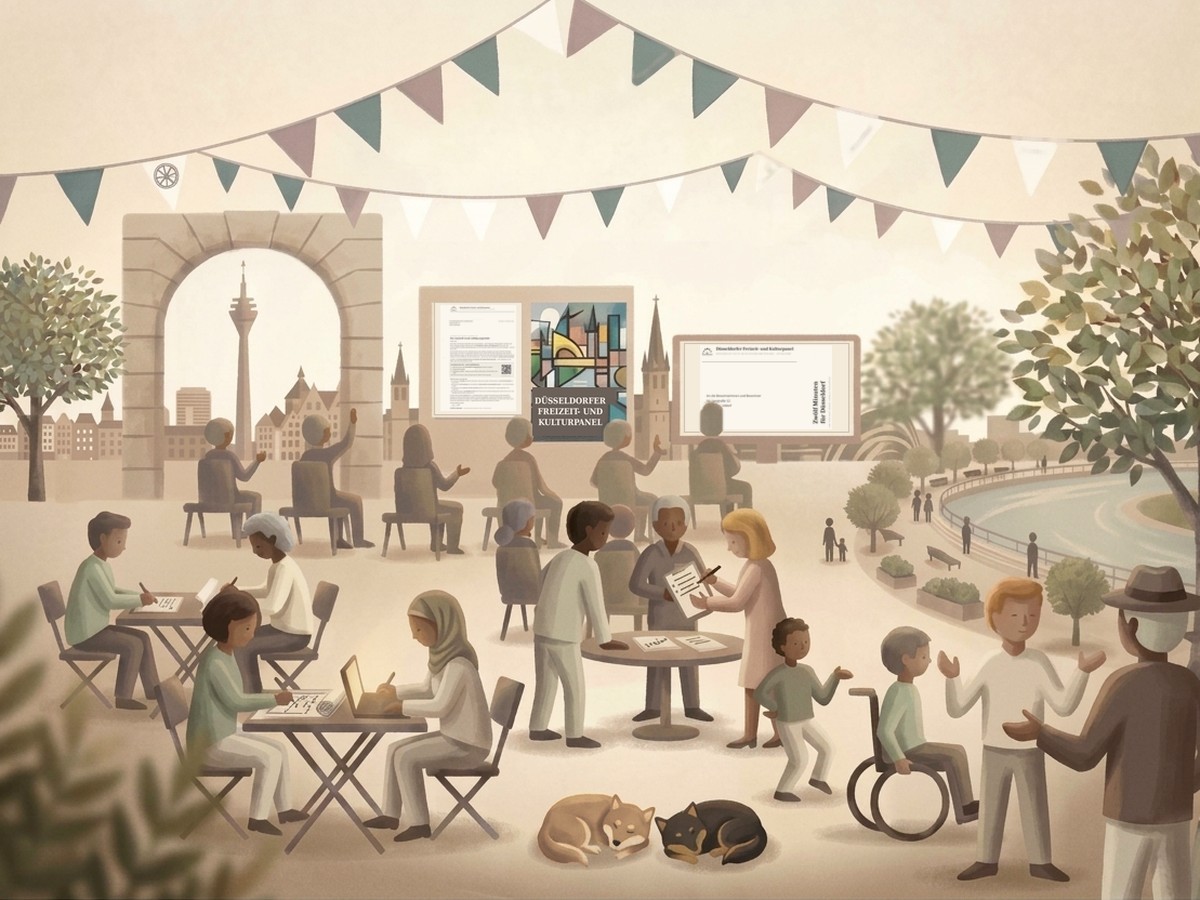
What holds a city together is not only family, work and community. It is also the fleeting forms of togetherness that arise, for instance, around leisure and cultural offerings.
Whether such encounters carry weight, and how relevant they are to living together, we hardly know. So we ask the people who live here.
From your neighbourhood to your last cultural outing
The questionnaire follows that order: first the city you live in, then your free time, then culture — what interests you, what you use, and what has changed.
-
Living in Düsseldorf How long you have been here, how you live, what you see as the city's biggest problems — and whether things are getting better or worse. Why we ask this -
Your free time How many hours you have left, what you most like to do, which obligations take up your time — and where you volunteer. Why we ask this -
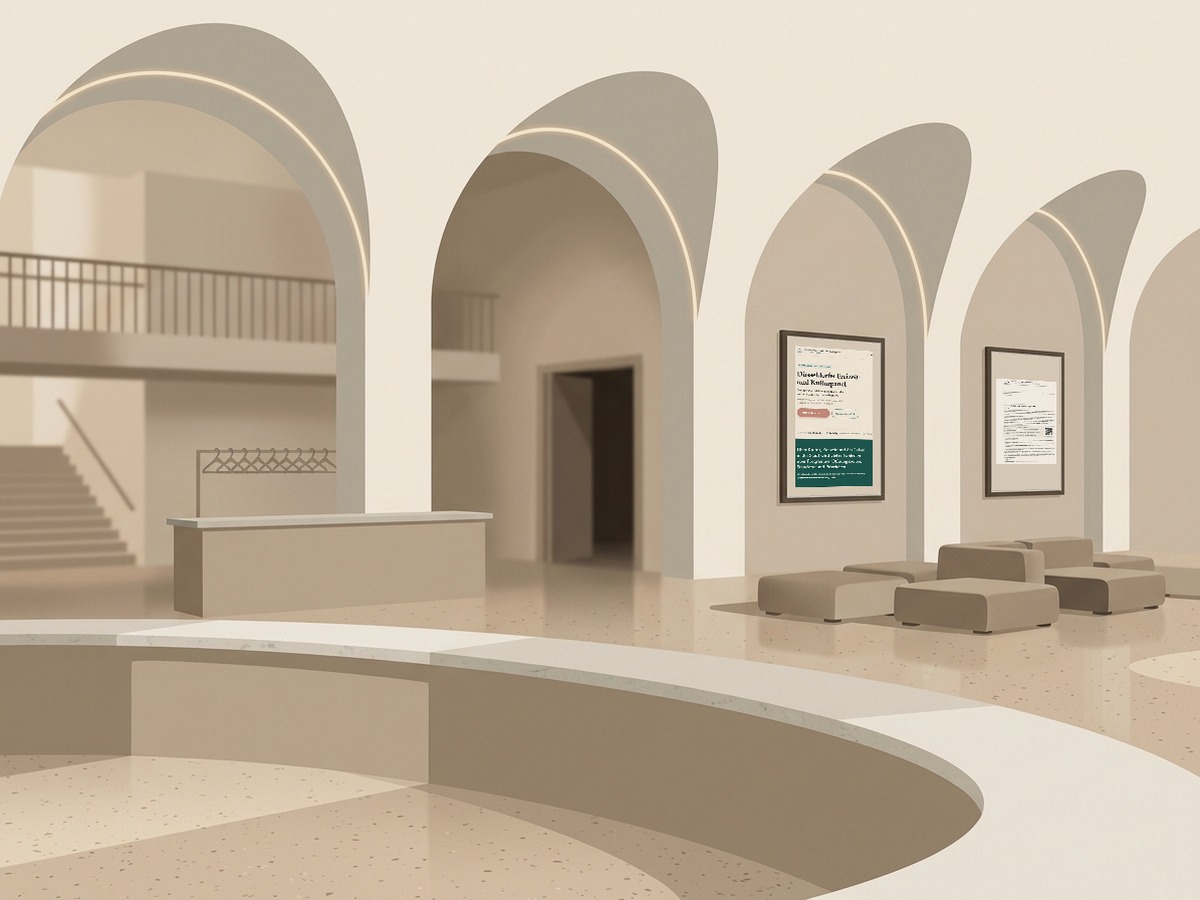
Culture: interest, access, community What interests you, where you go, what holds you back — who you go with and whether you feel you are meant. Why we ask this
Take part
The whole portal and the questionnaire itself are available in English. You can switch language inside the questionnaire at any point — even halfway through — and the answers you have already given are kept. If a question is still unclear, please call or write to us.
You enter your access code inside the questionnaire — it is the first question there; clicking the box takes you straight there. Eight characters in two blocks, e.g. XXXX-XXXX. Upper and lower case do not matter. You will find it on your letter or participation card.
XXXX-XXXXWho in your household should answer. The letter went to an address, not to a name, so a fixed rule decides who replies: the adult member of the household who had their birthday most recently. This keeps the choice within the household independent of who opens the post or who happens to have time — which is what keeps the result meaningful for the population as a whole. Please pass the code on if it applies to someone else.
Keep your letter at hand and click here:
Go to the questionnaireNo registration, no password, no user account. The access code alone is enough. It serves only to avoid duplicate participation and to keep us from writing to you again — your answers are stored separately from the code.
Lost your code, or is it illegible? Get in touch — we will send you a new one. Prefer paper? Request a printed questionnaire.
How it works
- Who in the household answers The person to answer is the adult in the household who had their birthday most recently — not necessarily whoever opens the envelope. The reason is set out under Why you?
- Open the questionnaire and enter the code The first page of the questionnaire asks for the eight characters from your letter. Nothing else is asked for.
- Fill in the questionnaire Around twelve minutes. You can interrupt at any time and continue later with the same code.
- Done Your answers go into the analysis in anonymised form. Results will appear later under Articles.
No code yet? Letters go out from 9 October 2026 — in city district 1 to begin with. Only households whose address was drawn can take part; that is precisely what makes the result meaningful. More on the sample
How it works, in two minutes
The letter, the draw, the access code and what happens to your answers. Subtitles in 21 languages — switched on with the icon in the player. Below, you can read what is said and what is shown.
What is said and shown in the video
Title card on sand: the panel’s logo, below it „Düsseldorfer Freizeit- und Kulturpanel“ and the line “Wave 1 · City district 1 · from October 2026”.
Welcome to the Düsseldorfer Freizeit- und Kulturpanel. Your survey on leisure, culture and life in this city.
A white landscape-format envelope on a light background. At the top, the logo and the words “Düsseldorfer Freizeit- und Kulturpanel”, below it in large letters “Leben in Düsseldorf — Bevölkerungsstudie” (Living in Düsseldorf — population study) and a drawn silhouette of the city.
These weeks, the same envelope arrives in hundreds of Düsseldorf letterboxes.
The envelope opens, the letter becomes visible. The subject line reads “Your address has been selected at random”.
If you have received an envelope, it is a genuine invitation. And it did not go to everyone.
A map of Düsseldorf with the official district boundaries. Dots are spread across the whole city. Then city district 1 turns green, labelled “364 of 2,300 sampling districts”. A single dot inside it lights up in terracotta and is labelled “Your address”. Along the bottom edge is the source note for the geodata.
The addresses come from the official geodata of North Rhine-Westphalia. They were drawn by a procedure modelled on the microcensus. First city districts, then addresses within them. No names, no card index, and no list of interested people.
An empty foyer with high round arches and pictures on the walls. Not a soul in it. Across the scene, daylight turns into evening light.
So you are meant even if you never go to the theatre. And use no other leisure offerings either. Especially then. A study that includes only visitors can only see visitors.
The letter in close-up. On the right a QR code, on the left the section “How to take part” with the access code K7RM-3TQP.
No one can replace you. And taking part does not take long. Scan the QR code, or type www.duesseldorfer-kulturpanel.de into your browser,
The portal’s home page with the button “Take part now”. Then the page “Access to the survey”: K7RM-3TQP is typed into the code field, the mouse pointer presses “Go to the questionnaire”.
then enter the eight-character access code from the envelope. And you are ready to start. No account, no password.
A questionnaire page on a tablet: “The questionnaire should be filled in by the adult in your household who had their birthday most recently. Are you that person?” with the answers Yes and No. The mouse pointer selects an answer and clicks “Next”.
But who in the household should reply? The adult who had their birthday most recently.
The next page: “How strongly do you feel connected to Düsseldorf?” with five steps from “Not at all” to “Very strongly”. Then a page with a free text field on the question of the biggest problems in Düsseldorf; a sentence is typed into it.
We ask about life in Düsseldorf, about your leisure time and the offerings in our city, and about your interests and experiences with them.
A table after work: a cup with steam rising from it, books, a window with frosted glass.
You can pause the questionnaire at any time, and continue later with the same code.
Two cards side by side. On the left “Your address” with the sample address and the access code, on the right “Your answers” with an answered question. The two are joined by a line; the line tears in the middle, and the cards move apart. Below appears: “Connected only by the access code. Once the survey is complete, this connection is deleted.”
Your answers are stored separately from your address, and analysed only in aggregate form. No prize draw, no rewards, no clients.
The letter once more. The sentence “The access code arrives by post only” is highlighted.
The access code arrives by post only.
The closing card: logo, „Düsseldorfer Freizeit- und Kulturpanel“, the address duesseldorfer-kulturpanel.de with a terracotta underline, below it “Your answer counts, even if you do not go.” and in small type “A private, independent study by Christian Sondergeld”.
The Düsseldorfer Freizeit- und Kulturpanel. Your answer counts, even if you do not go.
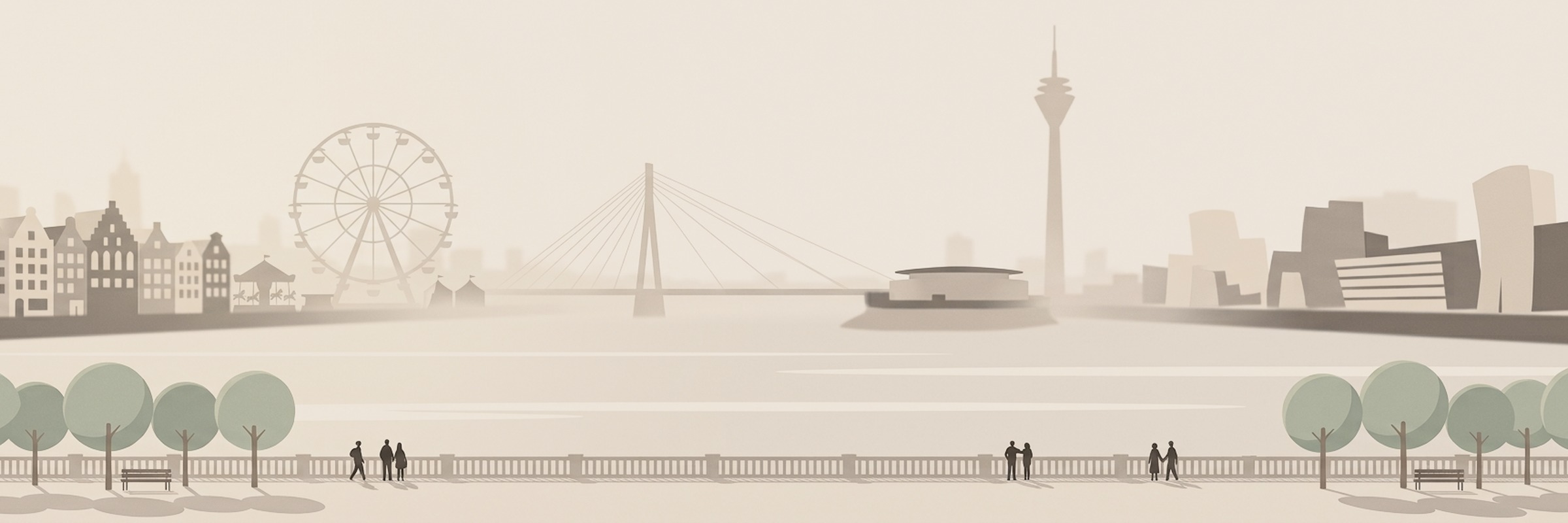
A view across the Rhine: the riverside promenade with a few people walking, the Ferris wheel, the bridge and the television tower. Then the closing card again, which stays. With music: „Tell Me How“ by The Stockwells.
Chance selected you — and nobody can stand in for you
Your address came out of the draw
A random procedure drew a limited number of residential addresses from the official geodata of the state of North Rhine-Westphalia, and yours was among them.
We did not select you because you are interested in culture or because you left your data somewhere.
Nobody can replace you
Only if every address has the same chance of being drawn do the results allow conclusions about the population of the city district surveyed — and, once the survey is extended, about the city as a whole. Nobody else is substituted for a household that does not reply: the gap remains, and with it the bias.
The same holds inside your household. That is why the person to answer is not whoever opens the post, but the adult who had their birthday most recently — a rule that favours nobody, because a birthday has nothing to do with the subject of the survey. Taking part is nevertheless voluntary.
What this survey is not
- Nothing is sold to you and nothing is advertised.
- Your invitation arrives by post, never by email; we never ask for bank details, passwords or identity numbers.
- There is no prize draw and no reward — your participation is not meant to be bought.
- Your address data is not passed on and not used for any other purpose.
- The panel is neutral in world view and party politics, does not interfere with artistic freedom and does not seek to educate anyone — what we commit to.
- There is no institute behind the survey. Who vouches for its design instead is set out openly under Voices on the panel. The commitments are currently being gathered.
If you want to know more
Everything essential has its own page — all of them in English, apart from the version in plain German.
Help Centre
Eleven frequently asked questions with a search box — in English.
OpenContact
Email address, what to include, and who to speak to — in English.
OpenThe study
Purpose, who conducts it, sample and course of the panel.
OpenData
What is collected, how long it is kept, who evaluates it.
OpenTechnology
Browsers, smartphones, accessibility, troubleshooting.
OpenVoices on the panel
Who supports the design of the survey with their name — and what that support expressly is not.
OpenLeichte Sprache
Plain German: short, simple sentences. Often easier than the standard pages.
OpenNews
The questionnaire for the pilot study is ready
What to expect, on a single page: eight stages from “who answers?” to the details about yourself — without giving the questions away. Not a test, not a quiz, no right answers. The summary is available as a PDF in English and German.
Read the entry-
The survey begins
From this day the letters are delivered in city district 1.
-
The survey starts as a pilot study
The first wave is surveyed in city district 1 first, not across the whole city.
-
Short portrait of the study
Who is asking, what it is about and what we let ourselves be measured against — on one page.
Who to contact
Call or write. On the phone, an AI assistant takes your request first — the reply comes from the study management in person.
We never send your access code by email and never ask for bank details or passwords. The code arrives by post only.
Twelve minutes for Düsseldorf
Do you have your access code to hand? This is where it starts.
Go to the questionnaire